Fugitive Spaces
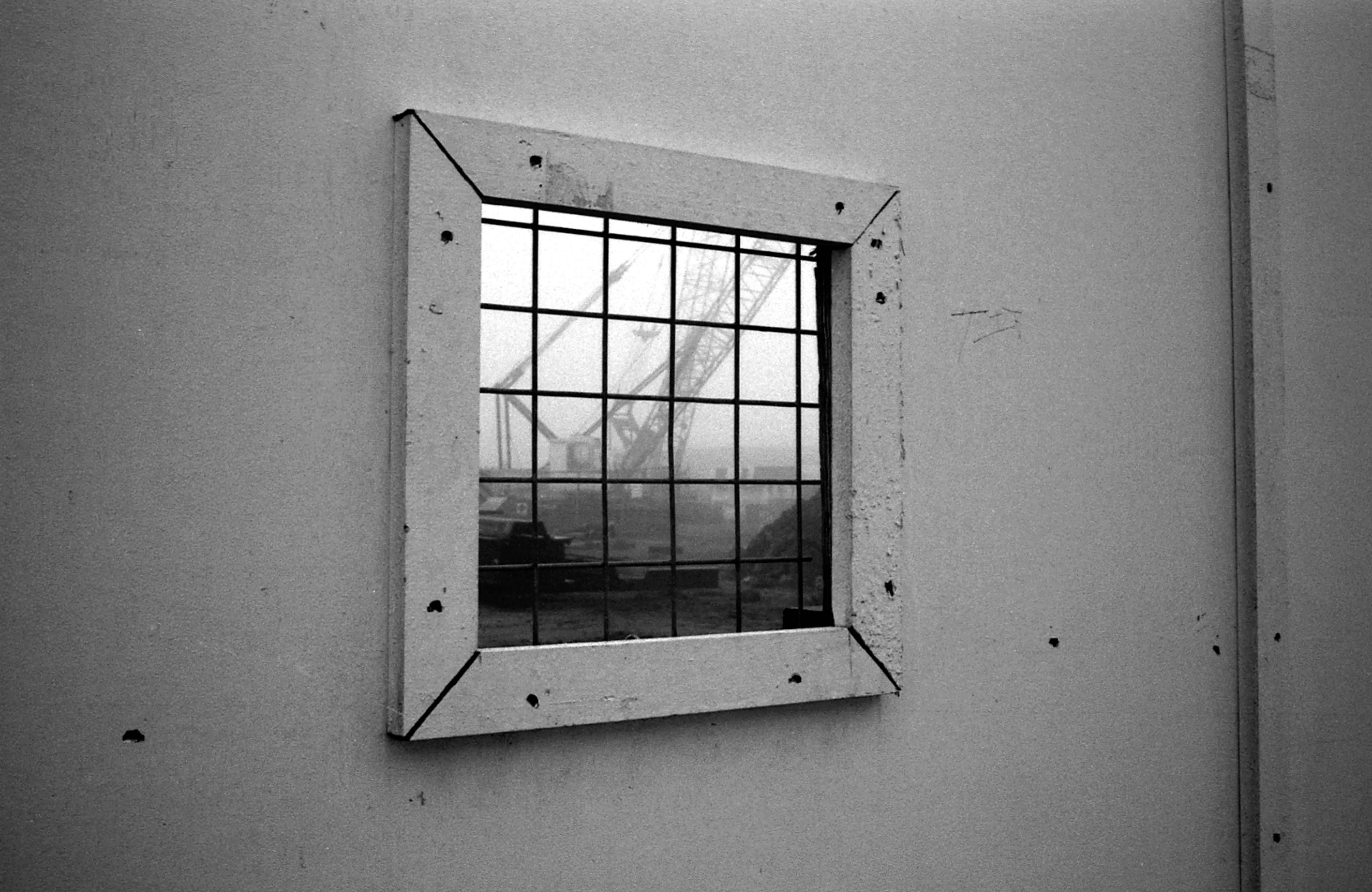
Two days before Christmas, another thick fog covered London. In December of 2006 a plague of mist had sent me out after ghosts on Hampstead Heath; when I saw the same romantic desolation this year, I took two cameras and a handful of film and went to find the industrial Thames at East Greenwich. Away from the Observatory and the Cutty Sark, this Greenwich keeps a rough, working feel. The coaling platform in the river no longer scoops fuel from passing ships, but the Edwardian power station still makes its electricity from gas.
I had thought to photograph the place as it was sixty years ago — fog billowing through streets of terraced houses. The mist would not co-operate; it lingered high and merely obscured the rooftops. No neo-Gothic postcards here. Silver and red decorations crowded the little windows, but no one stirred inside. The curved residential street emptied into a wider road; a shabby pub opposite advertised that evening’s Christmas quiz, and I wondered which way to walk. The road ahead seemed all the broader and more desolate for the low mist that swallowed anything above two storeys. A Thames Path sign pointed toward a bleak clearing between an aluminium wall and a tattered wire fence around a building site, where iron girders and heaps of upturned earth resolved, through the little squares of the fence, into a kind of cubist painting. A riverside walk appealed; I hoped for an Underground station at the end of it. A hat and scarf kept out most of the cold, but the metal cameras froze my fingers.
I walked on until I reached another narrow corridor, this one between a building-site fence and a graffiti-strewn wall. I stopped over a busy composition — six wooden posts set as bicycle barriers, the swoop of the wall to my right, the ghost of a smokestack rising in the distance — made a few frames, and was reloading the old Rollei when three young men passed. I am not usually unnerved by a group of youths, but the isolation of the fog gave me pause. I smiled; they seemed harmless enough, and I carried on. Beyond the posts the path opened onto a fog-covered Thames and two moored barges. The men had stopped in the exact spot I wanted, so I smiled again and set up beside them. I had shot a few frames and was considering the next when one of them asked, “How much do you think that camera is worth?”
At heart I am a country boy, but I have spent most of my adult life in and around New York and London, and I know enough to weigh all the possibilities of an encounter like that. These were shabby, slender, listless boys, carrying no weapons and, beyond the one question, not much interested in me. Did they mean to shake me down, or were they simply bored? In the same second I reckoned I could smash the questioner’s face with my tank of a camera, put the second into the Thames, and trust the third to be shocked enough to run. I hoped very much it would not come to that.
“This one? Not terribly much — which is rather why I use it by the water.” I made a few more pictures and left them where they stood at the river’s edge. The encounter seemed as opaque as the weather.
From there the path hewed to the curve of the bank, past a succession of piers and jetties. Industrial complexes loomed to my right; irregular polygons of steel jutted from the water. On clusters of weathered piling, cormorants kept watch over a river that undulated into the suppleness of the fog. I saw no horizon — only a seamless scattering of grey vapour.
The path emptied into a broad, muddy dock. Thick knotted ropes trailed off the edge into the water, and I photographed the dim shape of a barge whose stern tapered into nothing. A motor whirred; the craft swivelled, all at once, like some great alligator, and tacked toward me until I could read her name — The Thames Bubbler. She moved off westward as another vessel passed, silent, the other way. For some miles I walked on through an otherworldly landscape of heavy machinery, shattered gangplanks, discarded pipe, broken fences and unknowable reaches of the river.
Eventually I came to a domed ventilation shaft, a wall whose graffiti exhorted me to “Look up” at nothing but sky, and a derelict hotel near the O2 and North Greenwich station. I wiped the grime from my shoes and took the Jubilee Line back into central London to finish my Christmas errands, and bought a coffee, and sat a while with the warmth of the shop and the strange contentment the morning had left in me. In this world of endless change, where we keep nothing for long, I love fugitive spaces — the railway station, the teeming street, the underground platform, the meadow, the cornfield, the deserted riverbank. I am called to wander, to witness, to record, and to share what I find; and so, I think, are we all — until we are no more.
Explore images of this morning in And when I crumble who will remember.