This Is the State of the Union
Athol, Massachusetts · 2010
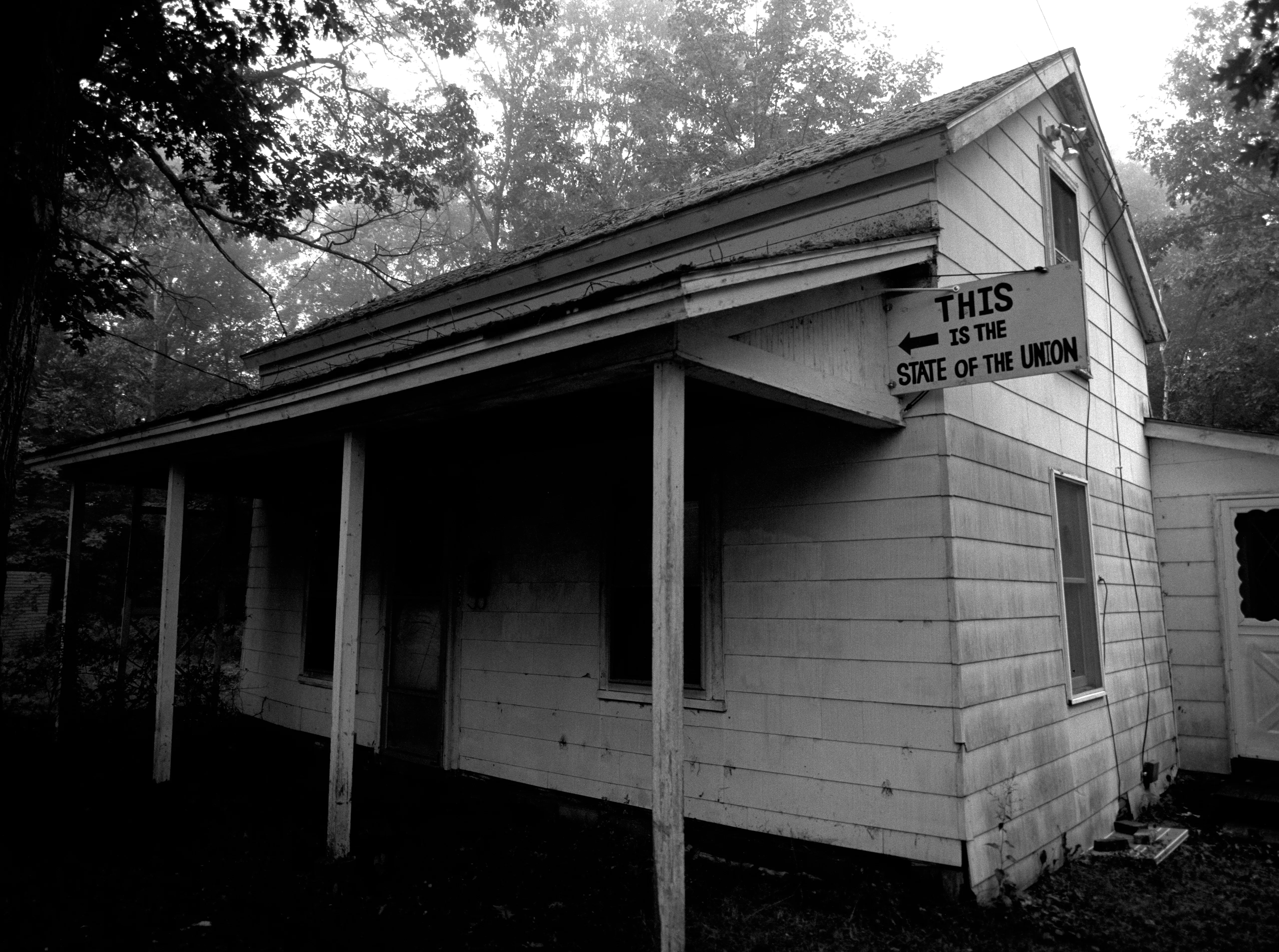
In 2010 I travelled to Athol, a quiet mill town in central Massachusetts. I woke at dawn to a deliciously thick fog, but the sun came through too hard and too quickly, and the morning gave me a single image: a small house on Silver Lake Street wearing a hand-painted sign — THIS IS THE STATE OF THE UNION — with an arrow that pointed back at the house itself. From somewhere inside came cheery classical music, at odds with the grim condition of the exterior.
I made a couple of exposures and walked on. Several minutes down the road I heard someone calling — hey, hello, you! — a man with a moustache and long hair, out of breath from running a fair way to catch me up. Was I photographing his house? Would I like to know the meaning behind the sign?
I accepted his offer of coffee. He had recently bought the house and it was sparsely furnished but new inside. We talked for over an hour. What follows is his story, in his own words.
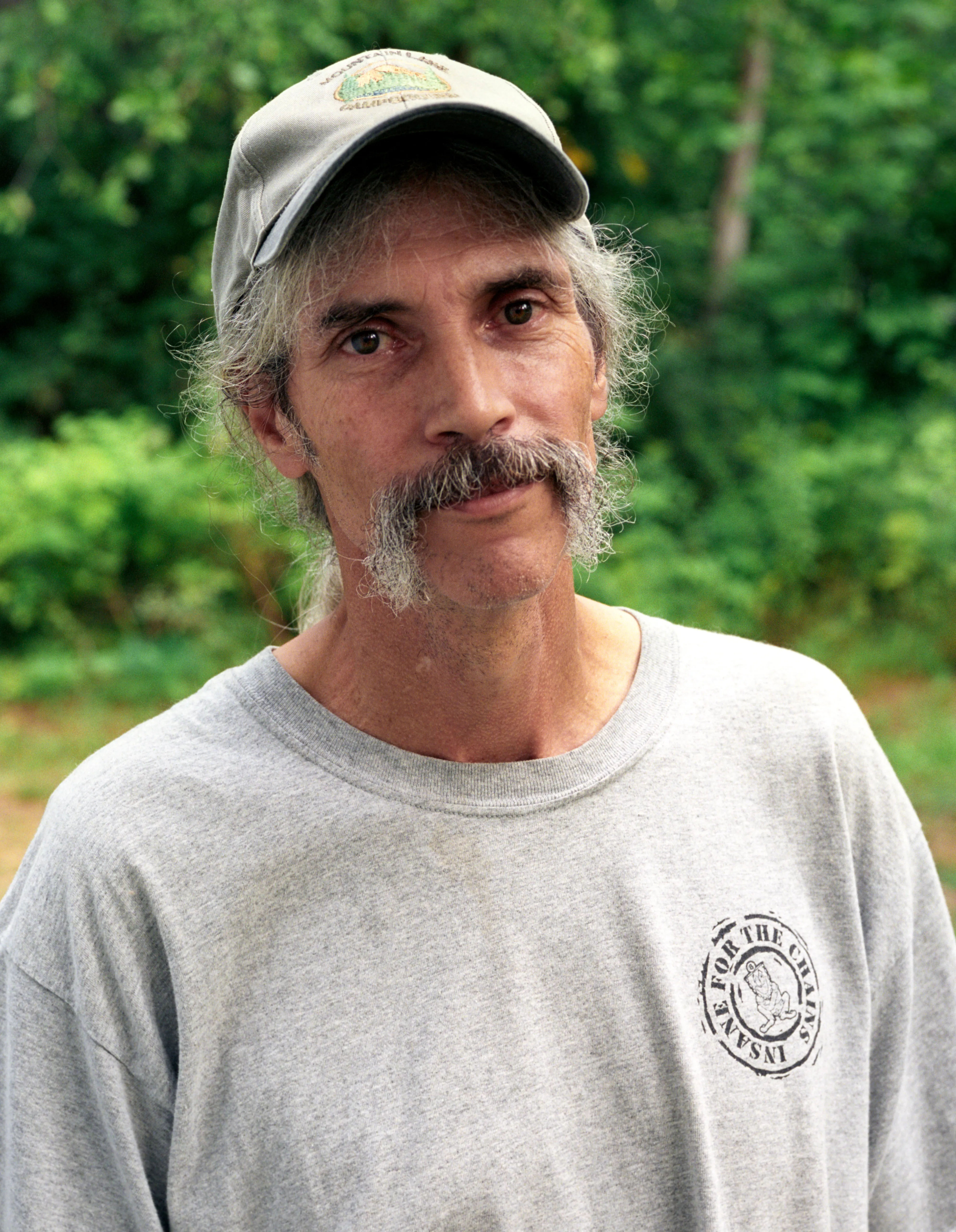
I was in the First Marine Air Wing from 1970 to 1974, back during Vietnam — but I didn't go to Vietnam. I went to Okinawa. I worked in safety and survival, which took care of the ejection seats, and overseas, in helicopters, we took care of the fire systems. Say somebody shoots a missile at a helicopter — they have a package of almost like fireworks in the back that locks on to that missile, and if it's a heat-seeker it'll follow the armament instead of the exhaust, and the helicopter drops quickly and the missile goes away. So we were saving people's asses, either that way or with the jets.
You know who Carlos Castaneda was, back in the seventies — an author? He had done a series of books about a medicine man down in Mexico that he had learned from. Don Juan, which was the guy's name, had opened up the eyes of Carlos to the way the world really is. And that's basically what the military did for me. It got me out of my small town and it said: this is what's behind the veil. And when I came back, I could no longer fit back into society the way that other people normally do, that are still living the illusion.
I was sitting right down there, having my breakfast one day, and I looked at the houses on the street and I said: it isn't me that's lost it. It's them. Melissa Etheridge has some wording in one of her songs, talking about the American public — they never woke up from the American dream. We all think that we're equal. We all think we can achieve greatness. Everybody's entitled to a house and a car and a family. But that's not the way it is anymore. And people are still living that illusion. So when I sat in the chair and I looked out, I saw all these people that were competing with a system that was falling apart from the inside.
The only thing that keeps it going, I think, is the fact that people can still charge. They can still put stuff on credit. You can throw it on plastic. And that's keeping everybody alive.
I think this community is more self-sufficient than most towns I've lived in. They have that mentality: if it comes, okay; if it don't come, okay. They're still going to be able to go on. And they're quite a community of people — everybody knows everybody. Not that they get in your business, but they know what's going on. This lady over here, she's been very nice to me, and she don't know me. I gave her some of my poetry. I said: if you want to understand me, read my poetry. And I told her if she didn't like it, she could pray to God and tell him, because that's where I think it came from.
I was a welder for forty years — made the trucks for the power companies. And in a way I felt like I was in contact with God, communicating with him on a regular basis. Because under the helmet, when you're welding, after you've welded long enough, it's almost mindless, and so you can drift. I used to flip my helmet once in a while and go: wow, is this neat? And people would go: what the fuck's wrong with you? Everything is electromagnetic energy. Every once in a while I'd have these thoughts, and I'd take a piece of soapstone out of my pocket — we had concrete floors — and I'd write it out on the floor so I wouldn't forget it. People would come by and see all these little philosophical writings. I felt like a college professor with an inspiration — he grabs the chalk, he's on the blackboard, and somebody comes in and goes: you got that wrong. And they start adding to it. I think that's what life is.
They talk now about what they call the holographic universe. And they think that dark matter represents the potential for manifestation. It's like a soup — almost like a photographic element, where if the right conditions exist, that liquid that is a photographic developer actually creates an image. That's the whole idea with the shutter: the shutter pops, it gets cast with that combination, and that's what blips out on the film, because that fluid has the ability to do that. Dark matter may be the same thing. A thought is cast against dark matter — and when it is, dark matter acts like the photographic fluid that manifests whatever it is that that thought is.
Can I get you to read me a poem? Do you mind if I record it?
Sure. No problem. This is one I do at the Renaissance fairs. It talks about Merlin and a king, and they have this conversation.
Enchantment
The King Summoned Merlin near,
And said, My Wizard, Something I fear,
Is Happening, Right under My nose,
And before its Lost, Before no one Knows,
I wish for You, To savour what We feel,
In Writings and such, That Time can't conceal,
For Progress, Devours a little each Day,
With the passage of Time, The price We pay,
Is too High, If We lose ourselves to the Wheel,
And forget who We are, And what is Real,
So hasten the Pen, Capture these Thoughts,
Before what has been, Soon will be Not,
A Reminder perhaps, Of this enchanted Time,
When Love was the Essence,
That dwelled Within
Our Minds!
Huzzah.
When the poem ended he told me how he had spotted me that morning. He had been on the phone with his sister — the sister who made the sign, whose name is signed in its corner — when a figure stopped at the edge of the yard. You're not going to believe this, he told her down the line. There's a guy out here taking a picture of your sign.
The arrow on the sign pointed back at the house. For all I know, it still does.